Important Details
IJCRT - International Peer Reviewed, Open Access Journal, Multidisciplinary, Monthly, Nominal(Low) Fees for Professional Research Services International Journal of Creative Research Thoughts - IJCRT Peer Review Journal, Refereed Journal, Peer Reviewed Journal , Referred Journal and Indexed Journal, Open access, Online and Print Journal,international Journal Open Access, Accepted by Indian and foreign university ,IJCRT Followed Norms, guidelines, requirement, listing criteria and methodology of score/point also applied from: Scopus , Web of Science , UGC Approved , UGC CARE, UGC-CARE .
UGC Approved Journal No: 49023 (18)
UGC approval Link
https://ijcrt.org/ugc%20approval.jpg
All Policy and Approval
Please Like Our Facebook Page | CrossRef DOI and Hard copy of Certificate Provide if required. | www.IJCRT.org | editor@IJCRT.org | IJCRT WhatsApp +91 94294 58311
Publication Details:
- Paper Submission : 31-Oct-2026. Call For Paper (Volume 14 | Issue 9 | Month- September 2026)
- Acceptance/Rejection Notification: Within 02-04 Days.
- Paper Publish: Within 02-04 Days after submitting all documents.
-
Submit Your Paper Any time There No deadline.
-
Publication fees : 1570 INR for Indian author & 59$ for foreign International author.
Please Like Our Facebook Page | CrossRef DOI and Hard copy of Certificate Provide if required.
Licence and Indexing
Indexing In Google Scholar, SSRN, ResearcherID-Publons, Semantic Scholar | AI-Powered Research Tool, Microsoft Academic, Academia.edu, arXiv.org, Research Gate, CiteSeerX, ResearcherID Thomson Reuters, Mendeley : reference manager, DocStoc, ISSUU, Scribd, and many more | High Impact Factor: 7.97 | Digital object identifier (DOI) and Hard Copy of certificate Provided.




























Licence
DOI
ISSN Approved impact factor: 7.97 
Creative Common 
Valid as per new UGC Gazette regulations 

INTERNATIONAL JOURNAL OF CREATIVE RESEARCH THOUGHTS - IJCRT (IJCRT.ORG)
International Peer Reviewed & Refereed Journals, Open Access Journal
IJCRT Peer-Reviewed (Refereed) Journal as Per New UGC Rules.
ISSN Approved Journal No: 2320-2882 | Impact factor: 7.97 | ESTD Year: 2013
Call For Paper - Volume 14 | Issue 9 | Month- September 2026
Scholarly open access journals, Peer-reviewed, and Refereed Journals, Impact factor 7.97 (Calculate by google scholar and Semantic Scholar | AI-Powered Research Tool) , Multidisciplinary, Monthly, Indexing in all major database & Metadata, Citation Generator, Digital Object Identifier(CrossRef DOI)
IJCRT WhatsApp Contact
IJCRT Search Xplore - Search all paper by Paper Name , Author Name, and Title
Volume 14 | Issue 2 |
Volume 14 | Issue 2 | Month
Downlaod After Publication 1) Table of content index in PDF
2) Table of content index in HTML 2)Table of content index in HTML
3) Front Page 3) Front Page
4) Back Page 4) Back Page
5) Editor Board Member 5)Editor Board Member
6) OLD Style Issue 6)OLD Style Issue
 |
 |
|---|---|
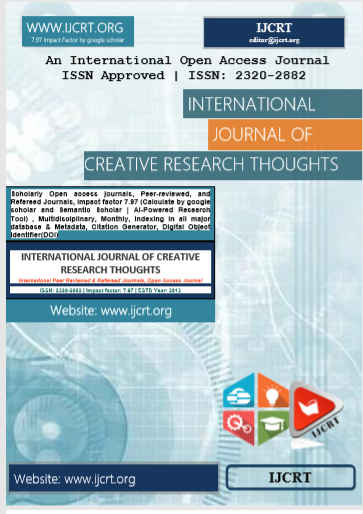
| IJCRT Journal front page | IJCRT Journal Back Page |
Paper Title: REVIEW ARTICLE ON ROLE OF PANCHAKARMA IN ARDHAVABHEDAKA(MIGRAINE).
Author Name(s): Dr Kalyani Jagannath Bhelke, Dr Sachin Gandhi
Published Paper ID: - IJCRT2602302
Register Paper ID - 301378
Publisher Journal Name: IJPUBLICATION, IJCRT
DOI Member ID: 10.6084/m9.doi.one.IJCRT2602302 and DOI :
Author Country : Indian Author, India, - , -, - , | Research Area: Science and Technology Published Paper URL: http://ijcrt.org/viewfull.php?&p_id=IJCRT2602302 Published Paper PDF: download.php?file=IJCRT2602302 Published Paper PDF: http://www.ijcrt.org/papers/IJCRT2602302.pdf
Your Paper Publication Details:
Title: REVIEW ARTICLE ON ROLE OF PANCHAKARMA IN ARDHAVABHEDAKA(MIGRAINE).
DOI (Digital Object Identifier) :
Pubished in Volume: 14 | Issue: 2 | Year: February 2026
Publisher Name : IJCRT | www.ijcrt.org | ISSN : 2320-2882
Subject Area: Science and Technology
Author type: Indian Author
Pubished in Volume: 14
Issue: 2
Pages: c693-c697
Year: February 2026
Downloads: 136
E-ISSN Number: 2320-2882
Abstract
Ayurveda is the ancient health science which has glorious past and bright future. It comprises many dimensions about health of human being. Ayurveda is a science of life. The main aim of Ayurveda is to maintain health in healthy persons and cures diseases in diseased persons. The life style of the people of modern era has changed due to rapid urbanization. Due to changed work expectations for better life style, stress is causing increased incidence of acute and chronic disorders. Ardhavabhedaka is one of the chronic illness, which is wide spread in the population with varying severity. Many chronic diseases which cannot be treated properly by other medical sciences, or there are side effects of the medicine or recurrence of the disease, those diseases were well treated by Ayurveda principles and medicines. Ayurveda has a variety of natural medication in the treatment of Ardhavabhedaka. Very elaborative treatment has been given in Ayurvedic Samhitas; especially Panchakarma offers significant relief in this disease. Ardhavabhedaka is best treated with Panchakarma like Shiro Virechana, Kaya Virechana, Nadisveda, Niruha and Anuvasana, Basti, Upanaha and Shiro Basti. Nasa is nearest root to alleviate the disease of head. Ayurvedic therapeutics especially Nasya karma has attracted considerable glamour for providing safe and effective remedies in the treatment of Ardhavabhedaka.
Licence: creative commons attribution 4.0
License
Creative Commons Attribution 4.0 and The Open Definition

Keywords
Ayurveda, Ardhavabhedak, Migraine, Panchkarma
License
Creative Commons Attribution 4.0 and The Open Definition
Paper Title: Artificial Intelligence in Forensic Science: Transforming Crime Investigation and Legal Accountability
Author Name(s): Dr. Veena Kumari, Vijay Kumar
Published Paper ID: - IJCRT2602301
Register Paper ID - 301361
Publisher Journal Name: IJPUBLICATION, IJCRT
DOI Member ID: 10.6084/m9.doi.one.IJCRT2602301 and DOI :
Author Country : Indian Author, India, 175042 , Mandi, 175042 , | Research Area: Others area Published Paper URL: http://ijcrt.org/viewfull.php?&p_id=IJCRT2602301 Published Paper PDF: download.php?file=IJCRT2602301 Published Paper PDF: http://www.ijcrt.org/papers/IJCRT2602301.pdf
Your Paper Publication Details:
Title: ARTIFICIAL INTELLIGENCE IN FORENSIC SCIENCE: TRANSFORMING CRIME INVESTIGATION AND LEGAL ACCOUNTABILITY
DOI (Digital Object Identifier) :
Pubished in Volume: 14 | Issue: 2 | Year: February 2026
Publisher Name : IJCRT | www.ijcrt.org | ISSN : 2320-2882
Subject Area: Others area
Author type: Indian Author
Pubished in Volume: 14
Issue: 2
Pages: c687-c692
Year: February 2026
Downloads: 153
E-ISSN Number: 2320-2882
Abstract
Artificial Intelligence (AI) is disruptive in forensic science; it leads to precision, effectiveness, and authenticity of criminal investigation. Although classical forensic approaches are efficient, they are faced with many barriers, such as human mistakes and limited time. Using AI algorithms (i.e. machine learning, predictive analytics, facial recognition, and natural language processing), forensic scientists will make efficient use of data of large volume and can search for patterns and reconstruct crime scenes. AI in digital forensics helps analyze images, videos, electronic records, and communications, while in biometrics it helps analyze fingerprints as well as DNA and facial recognition data. Tools that utilize AI also contribute towards the improvement of the investigative process by reducing human bias, whilst improving evidence in courts, ensuring accountability in the law. However, bringing AI into criminal justice includes ethical considerations about algorithmic bias, data privacy and the admissibility of evidence--regulatory oversight and standardization will be required to control all these considerations. Focusing this section on the latest state-of-the-art of AI in forensic science, the article discusses current examples which are providing concrete examples of how AI fits in the modern forensic landscape, and it deals with how it fits the intricate investigations and challenges associated with legal structures, validation ethics and ethical challenges (in particular, validating the data). If forensic science can adopt responsible methodologies to use AI technology, forensic science will see improved accuracy in investigations, faster resolution of cases and better decision making that can be supported by decision making that is a fundamental shift towards technologically enabled crime investigation.
Licence: creative commons attribution 4.0
License
Creative Commons Attribution 4.0 and The Open Definition
Keywords
Artificial Intelligence, Forensic Science, Crime Investigation, Digital Forensics, Legal Accountability, Machine Learning, Evidence Analysis, Ethical Concerns
License
Creative Commons Attribution 4.0 and The Open Definition
Paper Title: Multimorbidity Patterns and Therapeutic Complexity in Adult Medical Practice: Implications for Polypharmacy and Patient-Centred Care
Author Name(s): Dr. Rajeev Kumar, Mr. Ketan Sharma, Dr. Shiv Kumar Gupta
Published Paper ID: - IJCRT2602300
Register Paper ID - 301429
Publisher Journal Name: IJPUBLICATION, IJCRT
DOI Member ID: 10.6084/m9.doi.one.IJCRT2602300 and DOI :
Author Country : Indian Author, India, - , -, - , | Research Area: Science and Technology Published Paper URL: http://ijcrt.org/viewfull.php?&p_id=IJCRT2602300 Published Paper PDF: download.php?file=IJCRT2602300 Published Paper PDF: http://www.ijcrt.org/papers/IJCRT2602300.pdf
Your Paper Publication Details:
Title: MULTIMORBIDITY PATTERNS AND THERAPEUTIC COMPLEXITY IN ADULT MEDICAL PRACTICE: IMPLICATIONS FOR POLYPHARMACY AND PATIENT-CENTRED CARE
DOI (Digital Object Identifier) :
Pubished in Volume: 14 | Issue: 2 | Year: February 2026
Publisher Name : IJCRT | www.ijcrt.org | ISSN : 2320-2882
Subject Area: Science and Technology
Author type: Indian Author
Pubished in Volume: 14
Issue: 2
Pages: c679-c686
Year: February 2026
Downloads: 126
E-ISSN Number: 2320-2882
Abstract
Multimorbidity has become a characteristic problem of modern adult health care practise, especially in ageing societies and resource-limited health care. Polypharmacy, complicated pharmacological regimens, and increased susceptibility to adverse drug events, nonadherence, and functional impairment are often observed in the coexistence of a variety of chronic conditions. The article explores these issues: the patterns of multimorbidity and therapeutic complexity in adult medical practise will be studied using an integrative review of clinical, epidemiological, and systems-level evidence. Basing the analysis on primary and tertiary care, the findings have identified general disease clusters, the prescribing behaviour and the multidimensional predisposing factors that shape multimorbidity, such as behavioural risk factors, mental health issues, occupational exposures, social vulnerability and ageing. The review also addresses the clinical issues of guided care in complicated patients, focusing on the complexity of medication regimen, its suitability, and related morbidity and mortality risks. There is a special focus on vulnerable groups of people like older adults, women in occupations with high risks, tribal populations, and individuals with substance use and psychiatric conditions, which report disproportionate burden of therapy and worse outcomes. Other innovations addressed in the article, such as precision medicine, artificial intelligence, digital health tools, rehabilitation strategies, and patient empowerment models, are a set of potential outcome facilitators of more personalised and integrated care. On the whole, the synthesis highlights the necessity to no longer focus on disease-based models but rather on complexity-informed, patient-centred, and systems-integrated models of care as a way to effectively address multimorbidity and therapeutic complexity in adult medical practise.
Licence: creative commons attribution 4.0
License
Creative Commons Attribution 4.0 and The Open Definition
Keywords
Multimorbidity; Therapeutic complexity; Polypharmacy; Adult medical practice; Medication regimen complexity; Ageing; Mental health comorbidity; Patient-centred care; Digital health; Precision medicine
License
Creative Commons Attribution 4.0 and The Open Definition
Paper Title: Changing Consumer Purchase Behaviour in the Mobile Phone Market : A Comparative Study of Online and Offline Buyers in Madhya Pradesh
Author Name(s): Vijay Kumar Athnere, Dr. Deepak Tiwari, Dr. Sanjay Payasi
Published Paper ID: - IJCRT2602299
Register Paper ID - 301506
Publisher Journal Name: IJPUBLICATION, IJCRT
DOI Member ID: 10.6084/m9.doi.one.IJCRT2602299 and DOI :
Author Country : Indian Author, India, 462003 , Bhopal, 462003 , | Research Area: Management All Published Paper URL: http://ijcrt.org/viewfull.php?&p_id=IJCRT2602299 Published Paper PDF: download.php?file=IJCRT2602299 Published Paper PDF: http://www.ijcrt.org/papers/IJCRT2602299.pdf
Your Paper Publication Details:
Title: CHANGING CONSUMER PURCHASE BEHAVIOUR IN THE MOBILE PHONE MARKET : A COMPARATIVE STUDY OF ONLINE AND OFFLINE BUYERS IN MADHYA PRADESH
DOI (Digital Object Identifier) :
Pubished in Volume: 14 | Issue: 2 | Year: February 2026
Publisher Name : IJCRT | www.ijcrt.org | ISSN : 2320-2882
Subject Area: Management All
Author type: Indian Author
Pubished in Volume: 14
Issue: 2
Pages: c669-c678
Year: February 2026
Downloads: 133
E-ISSN Number: 2320-2882
Abstract
The mobile phone market in India has undergone a profound transformation with the rapid growth of e-commerce platforms and increasing consumer reliance on digital channels for information search and purchasing. Mobile phones, being high-involvement and technology-intensive products, exhibit complex consumer decision-making patterns influenced by price sensitivity, trust, perceived risk, convenience, warranty assurance, and after-sales service expectations. While online platforms offer competitive pricing, convenience, and extensive product information, offline retail outlets continue to attract consumers through physical inspection, immediate possession, personalized assistance, and localized service support. The present study examines the changing consumer purchase behaviour in the mobile phone market through a comparative analysis of online and offline buyers in Madhya Pradesh. Using primary data collected from consumers across selected urban and semi-urban districts, the study investigates differences in behavioural drivers such as price sensitivity, trust, convenience orientation, delivery preference, warranty perception, and after-sales service expectations. A quantitative research design is adopted, employing descriptive statistics, independent sample t-tests, chi-square analysis, factor analysis, and logistic regression to identify determinants of channel choice. The findings reveal statistically significant behavioural differences between online and offline buyers. Online buyers demonstrate higher price sensitivity and convenience orientation, whereas offline buyers exhibit stronger trust, preference for physical verification, clearer warranty perception, and higher after-sales service expectations. The study contributes region-specific empirical evidence from Madhya Pradesh and offers strategic insights for retailers, e-commerce platforms, and policymakers to design channel-appropriate marketing and consumer protection strategies.
Licence: creative commons attribution 4.0
License
Creative Commons Attribution 4.0 and The Open Definition
Keywords
Consumer Purchase Behaviour, Mobile Phone Market, Online Buying, Offline Buying, Price Sensitivity, Trust, Omnichannel Retailing, Madhya Pradesh
License
Creative Commons Attribution 4.0 and The Open Definition
Paper Title: Impact Of Institutional Agricultural Credit On Farm Productivity In Madhya Pradesh: A District-Level Empirical Analysis
Author Name(s): Dr. Muneer Hasan
Published Paper ID: - IJCRT2602298
Register Paper ID - 301498
Publisher Journal Name: IJPUBLICATION, IJCRT
DOI Member ID: 10.6084/m9.doi.one.IJCRT2602298 and DOI :
Author Country : Indian Author, India, 462001 , Bhopal, 462001 , | Research Area: Commerce and Management, MBA All Branch Published Paper URL: http://ijcrt.org/viewfull.php?&p_id=IJCRT2602298 Published Paper PDF: download.php?file=IJCRT2602298 Published Paper PDF: http://www.ijcrt.org/papers/IJCRT2602298.pdf
Your Paper Publication Details:
Title: IMPACT OF INSTITUTIONAL AGRICULTURAL CREDIT ON FARM PRODUCTIVITY IN MADHYA PRADESH: A DISTRICT-LEVEL EMPIRICAL ANALYSIS
DOI (Digital Object Identifier) :
Pubished in Volume: 14 | Issue: 2 | Year: February 2026
Publisher Name : IJCRT | www.ijcrt.org | ISSN : 2320-2882
Subject Area: Commerce and Management, MBA All Branch
Author type: Indian Author
Pubished in Volume: 14
Issue: 2
Pages: c664-c668
Year: February 2026
Downloads: 168
E-ISSN Number: 2320-2882
Abstract
Abstract This study investigates the impact of institutional agricultural credit on farm productivity in Madhya Pradesh using district-level panel data for the period 2014-2024. Institutional agricultural credit has been a major policy instrument in India for promoting rural development and enhancing farm income. However, empirical evidence at the district level remains limited. The study employs descriptive statistics, correlation analysis, and panel regression modelling to examine the relationship between credit disbursement and agricultural productivity while controlling for irrigation coverage, rainfall variability, and fertilizer usage. The findings indicate that institutional credit has a statistically significant positive impact on farm productivity. However, rising non-performing assets (NPAs) and regional disparities moderate this effect. The study contributes to agricultural finance literature by providing district-level empirical evidence and policy recommendations for strengthening credit delivery mechanisms in Madhya Pradesh.
Licence: creative commons attribution 4.0
License
Creative Commons Attribution 4.0 and The Open Definition
Keywords
Institutional Credit, Agricultural Productivity, District-Level Analysis, Rural Banking, Panel Regression
License
Creative Commons Attribution 4.0 and The Open Definition
Paper Title: Mountains, Humanity and Literature: Shanku Maharaj's Himalayan Journeys
Author Name(s): Dr. Mahadev Das
Published Paper ID: - IJCRT2602297
Register Paper ID - 301494
Publisher Journal Name: IJPUBLICATION, IJCRT
DOI Member ID: 10.6084/m9.doi.one.IJCRT2602297 and DOI :
Author Country : Indian Author, India, 721652 , -, 721652 , | Research Area: Humanities All Published Paper URL: http://ijcrt.org/viewfull.php?&p_id=IJCRT2602297 Published Paper PDF: download.php?file=IJCRT2602297 Published Paper PDF: http://www.ijcrt.org/papers/IJCRT2602297.pdf
Your Paper Publication Details:
Title: MOUNTAINS, HUMANITY AND LITERATURE: SHANKU MAHARAJ'S HIMALAYAN JOURNEYS
DOI (Digital Object Identifier) :
Pubished in Volume: 14 | Issue: 2 | Year: February 2026
Publisher Name : IJCRT | www.ijcrt.org | ISSN : 2320-2882
Subject Area: Humanities All
Author type: Indian Author
Pubished in Volume: 14
Issue: 2
Pages: c651-c663
Year: February 2026
Downloads: 214
E-ISSN Number: 2320-2882
Abstract
Shanku Maharaj's travel writings transcend the boundaries of conventional travelogues, evolving into a unique blend of literature, philosophy, and cultural documentation. With nearly fifty Himalayan-centered works, his narratives capture not only the grandeur and peril of mountain landscapes but also the human spirit encountered along the way. His journeys were driven not by religious merit but by an irrepressible desire to see, know, and connect with people across diverse terrains. Through vivid descriptions of nature's transformations, compassionate portrayals of mountain folk, and reflections on unity beyond caste, class, and creed, Maharaj's works embody both scholarly rigor and lyrical beauty. His accounts of places such as Gangotri, Yamunotri, Siniolchu, Ladakh, and Meghalaya reveal a deep engagement with history, geography, and human relationships, while his meticulous documentation of mountaineering records underscores his commitment to preserving knowledge. Ultimately, Shanku Maharaj's travel literature stands as a testament to the transformative power of journeying--where landscapes become living experiences, strangers become kin, and the pursuit of beauty and humanity becomes inseparable.
Licence: creative commons attribution 4.0
License
Creative Commons Attribution 4.0 and The Open Definition
Keywords
Shanku Maharaj, Himalayan Travel Literature, Philosophical Vision, Human Compassion, Nature and Landscape, Pilgrimage and Culture.
License
Creative Commons Attribution 4.0 and The Open Definition
Paper Title: Profile Hidden Markov Model Construction for Regulatory Motif Identification in DNA Sequence Families
Author Name(s): J. Jeslin, Dr. A. Radhika, K. Geetha
Published Paper ID: - IJCRT2602296
Register Paper ID - 301431
Publisher Journal Name: IJPUBLICATION, IJCRT
DOI Member ID: 10.6084/m9.doi.one.IJCRT2602296 and DOI :
Author Country : Indian Author, India, 636008 , Salem, 636008 , | Research Area: Applied Mathematics Published Paper URL: http://ijcrt.org/viewfull.php?&p_id=IJCRT2602296 Published Paper PDF: download.php?file=IJCRT2602296 Published Paper PDF: http://www.ijcrt.org/papers/IJCRT2602296.pdf
Your Paper Publication Details:
Title: PROFILE HIDDEN MARKOV MODEL CONSTRUCTION FOR REGULATORY MOTIF IDENTIFICATION IN DNA SEQUENCE FAMILIES
DOI (Digital Object Identifier) :
Pubished in Volume: 14 | Issue: 2 | Year: February 2026
Publisher Name : IJCRT | www.ijcrt.org | ISSN : 2320-2882
Subject Area: Applied Mathematics
Author type: Indian Author
Pubished in Volume: 14
Issue: 2
Pages: c646-c650
Year: February 2026
Downloads: 170
E-ISSN Number: 2320-2882
Abstract
Biological motifs consist of short conserved sequence patterns that serve essential regulatory and structural functions throughout DNA/RNA/protein molecules. The growing genomic data requires developers to solve the essential problem of motif identification and classification in computational genomics. The detection of position-specific conservation between multiple sequences proves difficult for traditional alignment based methods. The Profile Hidden Markov Model (PHMM) framework provides improved motif conservation representation through position dependent emission and transition probabilities to address the limitations. Current PHMM based studies use frequency calculations with weak sequence weighting methods that decrease model accuracy when motif sequences have different lengths. We develop a statistical PHMM model to analyze eukaryotic regulatory DNA motifs using a multiple sequence alignment of a few canonical motifs. The method uses Henikoff & Henikoff (1994) position-based sequence weighting together with Laplace pseudocounts to enhance probability estimation accuracy. To assess motif similarity, the Viterbi algorithm enables log-odds scoring. The results show that PHMMs successfully identify regulatory elements and provide statistical evidence for motif detection.
Licence: creative commons attribution 4.0
License
Creative Commons Attribution 4.0 and The Open Definition
Keywords
Profile Hidden Markov Model, DNA motifs, multiple sequence alignment, sequence weighting, Laplace pseudocounts, Viterbi algorithm, computational genomics
License
Creative Commons Attribution 4.0 and The Open Definition
Paper Title: Financial Restructuring and its impact on Employees with reference to IT Sector
Author Name(s): Ms. Harshitha M, Dr. S Umamaheshwari
Published Paper ID: - IJCRT2602295
Register Paper ID - 299947
Publisher Journal Name: IJPUBLICATION, IJCRT
DOI Member ID: 10.6084/m9.doi.one.IJCRT2602295 and DOI : https://doi.org/10.56975/ijcrt.v14i2.299947
Author Country : Indian Author, India, 560072 , Bangalore, 560072 , | Research Area: Commerce All Published Paper URL: http://ijcrt.org/viewfull.php?&p_id=IJCRT2602295 Published Paper PDF: download.php?file=IJCRT2602295 Published Paper PDF: http://www.ijcrt.org/papers/IJCRT2602295.pdf
Your Paper Publication Details:
Title: FINANCIAL RESTRUCTURING AND ITS IMPACT ON EMPLOYEES WITH REFERENCE TO IT SECTOR
DOI (Digital Object Identifier) : https://doi.org/10.56975/ijcrt.v14i2.299947
Pubished in Volume: 14 | Issue: 2 | Year: February 2026
Publisher Name : IJCRT | www.ijcrt.org | ISSN : 2320-2882
Subject Area: Commerce All
Author type: Indian Author
Pubished in Volume: 14
Issue: 2
Pages: c640-c645
Year: February 2026
Downloads: 259
E-ISSN Number: 2320-2882
Abstract
Financial restructuring has become a strategic requirement for businesses in today's unstable business environment, especially in the Information Technology (IT) sector, which is extremely vulnerable to changes in the global economy, technological disruptions, and competitive pressures. Cost optimization, workforce rationalization, mergers and acquisitions, debt restructuring, and adjustments to compensation structures are all common components of financial restructuring. These actions have a substantial impact on employees' job security, motivation, trust, and general work engagement, even though they are intended to improve the organization's long-term sustainability and financial health. With an emphasis on factors like job satisfaction, employee morale, organizational commitment, perceived job security, and performance, this study investigates how financial restructuring affects workers in the IT industry. A structured questionnaire was used to gather primary data from 380 IT workers in companies affected by restructuring using a quantitative research design. Data analysis was done using statistical tools like regression analysis, correlation analysis, mediation testing, and descriptive statistics. The results show that financial restructuring significantly affects employee attitudes and behavior, with workload and job insecurity serving as the main sources of stress. However, it was discovered that the detrimental effects were lessened by open communication, equitable HR procedures, and employee support systems. The study emphasizes how important human resource management (HRM) is in striking a balance between employee welfare and financial recovery during restructuring initiatives.
Licence: creative commons attribution 4.0
License
Creative Commons Attribution 4.0 and The Open Definition
Keywords
Key Words: Financial restructuring, IT sector, HRM practices, organizational commitment, job security, job satisfaction, and employee morale.
License
Creative Commons Attribution 4.0 and The Open Definition
Paper Title: Study of Nanotechnology with Application to removal of toxic pollutants from water
Author Name(s): Dr. Ranjan Prasad
Published Paper ID: - IJCRT2602294
Register Paper ID - 301192
Publisher Journal Name: IJPUBLICATION, IJCRT
DOI Member ID: 10.6084/m9.doi.one.IJCRT2602294 and DOI : https://doi.org/10.56975/ijcrt.v14i2.301192
Author Country : Indian Author, India, 847452 , SUPAUL (BIHAR), 847452 , | Research Area: Science and Technology Published Paper URL: http://ijcrt.org/viewfull.php?&p_id=IJCRT2602294 Published Paper PDF: download.php?file=IJCRT2602294 Published Paper PDF: http://www.ijcrt.org/papers/IJCRT2602294.pdf
Your Paper Publication Details:
Title: STUDY OF NANOTECHNOLOGY WITH APPLICATION TO REMOVAL OF TOXIC POLLUTANTS FROM WATER
DOI (Digital Object Identifier) : https://doi.org/10.56975/ijcrt.v14i2.301192
Pubished in Volume: 14 | Issue: 2 | Year: February 2026
Publisher Name : IJCRT | www.ijcrt.org | ISSN : 2320-2882
Subject Area: Science and Technology
Author type: Indian Author
Pubished in Volume: 14
Issue: 2
Pages: c634-c639
Year: February 2026
Downloads: 229
E-ISSN Number: 2320-2882
Abstract
Abstract: Access to clean and safe water is one of the most critical global challenges due to rapid industrialization, population growth, and increasing water pollution. Conventional water treatment technologies often face limitations in effectively removing emerging contaminants, pathogens, and heavy metals. In this context, nanotechnology has emerged as a promising and innovative approach for enhancing water purification processes. This study explores the application of nanotechnology in achieving clean and sustainable water resources. Nanomaterials, including carbon nanotubes, graphene oxide, metal and metal-oxide nanoparticles, nanocomposites, and nanostructured membranes, possess distinctive physicochemical characteristics such as large surface area, high reactivity, and adjustable surface functionalities. These characteristics significantly improve contaminant removal efficiency through mechanisms such as adsorption, photo catalytic degradation, antimicrobial activity, and membrane filtration. Nanotechnology-based systems have demonstrated superior performance in removing heavy metals, organic pollutants, dyes, microorganisms, and salinity compared to traditional methods. The study also highlights the role of nanotechnology in desalination, wastewater treatment, and point-of-use water purification systems, making it suitable for both urban and rural applications. Additionally, the integration of green synthesis methods and biodegradable nanomaterials promotes environmental sustainability and reduces potential ecological risks. Despite its advantages, challenges related to large-scale implementation, cost, nanoparticle toxicity, and regulatory concerns remain. Addressing these issues through responsible design and risk assessment is essential for practical deployment. Overall, nanotechnology presents a transformative solution for improving water quality and ensuring access to clean water, contributing significantly to public health and sustainable development goals.
Licence: creative commons attribution 4.0
License
Creative Commons Attribution 4.0 and The Open Definition
Keywords
Nanotechnology, Clean Water, Water Purification, Nanomaterials, Carbon Nanotubes, Emerging Contaminants.
License
Creative Commons Attribution 4.0 and The Open Definition
Paper Title: Impact of Pre and Post COVID 19 On E learning: Student Perspective from Indian Educational Institutions
Author Name(s): KHUSABU RAI, Dr. Sushma Agarwal
Published Paper ID: - IJCRT2602293
Register Paper ID - 301504
Publisher Journal Name: IJPUBLICATION, IJCRT
DOI Member ID: 10.6084/m9.doi.one.IJCRT2602293 and DOI :
Author Country : Indian Author, India, 284002 , Jhansi Khas, 284002 , | Research Area: Others area Published Paper URL: http://ijcrt.org/viewfull.php?&p_id=IJCRT2602293 Published Paper PDF: download.php?file=IJCRT2602293 Published Paper PDF: http://www.ijcrt.org/papers/IJCRT2602293.pdf
Your Paper Publication Details:
Title: IMPACT OF PRE AND POST COVID 19 ON E LEARNING: STUDENT PERSPECTIVE FROM INDIAN EDUCATIONAL INSTITUTIONS
DOI (Digital Object Identifier) :
Pubished in Volume: 14 | Issue: 2 | Year: February 2026
Publisher Name : IJCRT | www.ijcrt.org | ISSN : 2320-2882
Subject Area: Others area
Author type: Indian Author
Pubished in Volume: 14
Issue: 2
Pages: c623-c633
Year: February 2026
Downloads: 174
E-ISSN Number: 2320-2882
Abstract
The covid-19 has disrupted and shaken the entire world. Mostly it has affected learning and teaching of educational institutions. India is now witnessing a rapid shift from traditional chalk-talk teaching model to technology driven E- learning model. While E- learning has been increasing exponentially in recent years, India is now experiencing an E-Learning boom since pandemic has emerged. The E- learning experience has posed some challenges and directions for future of online education. The policy makers are now focussing on scaling and ensuring inclusive E- learning solutions with much updated hands on for both teacher and student. Yet it would be simply to assume that e- learning platform is progressing seamlessly like physical classrooms or not. Thus, objective of our study is to analyse the influential role of covid 19 pandemic in Indian education system specifically among student's cohort, significant contribution to E-Learning mode as a resource of learning. This paper also highlighted how E- learning plays a crucial role and panacea for all educational institutions by analysing awareness of students before and after the pandemic has emerged with insight on challenges and opportunities posed by pandemic. The research is based on both Quantitative and Qualitative Approaches. In this research primary survey and secondary data has approached. Primary Data were collected from 150 students and self-administered questionnaire was adopted to analyse information for the study. Analysis has followed descriptive statistics, gap analysis, scatter diagram.
Licence: creative commons attribution 4.0
License
Creative Commons Attribution 4.0 and The Open Definition
Keywords
COVID-19, Indian Education Mode, Online-Learning, Effect of COVID-19 and Challenges.
License
Creative Commons Attribution 4.0 and The Open Definition
Call For Paper September 2026
Call For Papers
September 2026
Volume 14 | Issue 9
Last Date :
31-Oct-2026
Submit Manuscript Online Impact Factor: 7.97 Review Results : Within 02-03 Days Paper Publication : Within 02-03 Days
September 2026
Volume 14 | Issue 9
Last Date :
31-Oct-2026
Submit Manuscript Online Impact Factor: 7.97 Review Results : Within 02-03 Days Paper Publication : Within 02-03 Days
Published Issue Details
For Authors
Forms / Downloads
Other IMP Links
Indexing Partner
Research Area
LICENSE





ISSN and 7.97 Impact Factor Details
ISSN: 2320-2882 Impact Factor: 7.97 and ISSN APPROVED Journal Starting Year (ESTD) : 2013


ISSN and 7.97 Impact Factor Details
ISSN: 2320-2882 Impact Factor: 7.97 and ISSN APPROVED Journal Starting Year (ESTD) : 2013
DOI Details
CONFERENCE
CONFERENCE MANAGMENT & PUBLICATION CONFERENCE PROPOSAL
RECENT CONFERENCE

CONFERENCE PROPOSAL CONFERENCE PROCEEDINGS
CONFERENCE PROPOSAL CONFERENCE PROCEEDINGS
For Reviewer /Referral (RMS) Earn 500 per paper
Important Links
NEWS & Conference
Digital Library
IJCRT RMS | Earn 500 Per Paper.

Open Access


LICENSE
Indexing Partner
Scholarly open access journals, Peer-reviewed, and Refereed Journals, Impact factor 7.97 (Calculate by google scholar and Semantic Scholar | AI-Powered Research Tool) , Multidisciplinary, Monthly, Indexing in all major database & Metadata, Citation Generator, Digital Object Identifier(DOI)