Important Details
IJCRT - International Peer Reviewed, Open Access Journal, Multidisciplinary, Monthly, Nominal(Low) Fees for Professional Research Services International Journal of Creative Research Thoughts - IJCRT Peer Review Journal, Refereed Journal, Peer Reviewed Journal , Referred Journal and Indexed Journal, Open access, Online and Print Journal,international Journal Open Access, Accepted by Indian and foreign university ,IJCRT Followed Norms, guidelines, requirement, listing criteria and methodology of score/point also applied from: Scopus , Web of Science , UGC Approved , UGC CARE, UGC-CARE .
UGC Approved Journal No: 49023 (18)
UGC approval Link
https://ijcrt.org/ugc%20approval.jpg
All Policy and Approval
Please Like Our Facebook Page | CrossRef DOI and Hard copy of Certificate Provide if required. | www.IJCRT.org | editor@IJCRT.org | IJCRT WhatsApp +91 94294 58311
Publication Details:
- Paper Submission : 30-Sep-2026. Call For Paper (Volume 14 | Issue 9 | Month- September 2026)
- Acceptance/Rejection Notification: Within 02-04 Days.
- Paper Publish: Within 02-04 Days after submitting all documents.
-
Submit Your Paper Any time There No deadline.
-
Publication fees : 1570 INR for Indian author & 59$ for foreign International author.
Please Like Our Facebook Page | CrossRef DOI and Hard copy of Certificate Provide if required.
Licence and Indexing
Indexing In Google Scholar, SSRN, ResearcherID-Publons, Semantic Scholar | AI-Powered Research Tool, Microsoft Academic, Academia.edu, arXiv.org, Research Gate, CiteSeerX, ResearcherID Thomson Reuters, Mendeley : reference manager, DocStoc, ISSUU, Scribd, and many more | High Impact Factor: 7.97 | Digital object identifier (DOI) and Hard Copy of certificate Provided.




























Licence
DOI
ISSN Approved impact factor: 7.97 
Creative Common 
Valid as per new UGC Gazette regulations 

INTERNATIONAL JOURNAL OF CREATIVE RESEARCH THOUGHTS - IJCRT (IJCRT.ORG)
International Peer Reviewed & Refereed Journals, Open Access Journal
IJCRT Peer-Reviewed (Refereed) Journal as Per New UGC Rules.
ISSN Approved Journal No: 2320-2882 | Impact factor: 7.97 | ESTD Year: 2013
Call For Paper - Volume 14 | Issue 9 | Month- September 2026
Scholarly open access journals, Peer-reviewed, and Refereed Journals, Impact factor 7.97 (Calculate by google scholar and Semantic Scholar | AI-Powered Research Tool) , Multidisciplinary, Monthly, Indexing in all major database & Metadata, Citation Generator, Digital Object Identifier(CrossRef DOI)
IJCRT WhatsApp Contact
IJCRT Search Xplore - Search all paper by Paper Name , Author Name, and Title
Volume 14 | Issue 4 |
Volume 14 | Issue 4 | Month
Downlaod After Publication 1) Table of content index in PDF
2) Table of content index in HTML 2)Table of content index in HTML
3) Front Page 3) Front Page
4) Back Page 4) Back Page
5) Editor Board Member 5)Editor Board Member
6) OLD Style Issue 6)OLD Style Issue
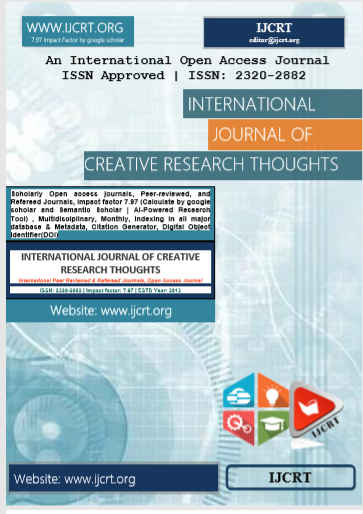 |
 |
|---|---|
| IJCRT Journal front page | IJCRT Journal Back Page |
Paper Title: Relevance of Savitribai Phule's Educational Revolution in the Present Context of India
Author Name(s): MONIKA SARDAR
Published Paper ID: - IJCRT2604109
Register Paper ID - 304789
Publisher Journal Name: IJPUBLICATION, IJCRT
DOI Member ID: 10.6084/m9.doi.one.IJCRT2604109 and DOI :
Author Country : Indian Author, India, 700150 , Kolkata, 700150 , | Research Area: Social Science All Published Paper URL: http://ijcrt.org/viewfull.php?&p_id=IJCRT2604109 Published Paper PDF: download.php?file=IJCRT2604109 Published Paper PDF: http://www.ijcrt.org/papers/IJCRT2604109.pdf
Your Paper Publication Details:
Title: RELEVANCE OF SAVITRIBAI PHULE'S EDUCATIONAL REVOLUTION IN THE PRESENT CONTEXT OF INDIA
DOI (Digital Object Identifier) :
Pubished in Volume: 14 | Issue: 4 | Year: April 2026
Publisher Name : IJCRT | www.ijcrt.org | ISSN : 2320-2882
Subject Area: Social Science All
Author type: Indian Author
Pubished in Volume: 14
Issue: 4
Pages: a884-a891
Year: April 2026
Downloads: 130
E-ISSN Number: 2320-2882
Abstract
Education is a powerful tool for changing society. In the century India had a lot of social problems like caste hierarchy, patriarchy and religious orthodoxy. At that time educating women and lower-caste groups was an idea. Savitribai Phule was one of the people to challenge these social problems through education. She started a movement with her husband Jyotirao Phule to make education accessible to women, Dalits and other marginalized communities. Savitribai Phule opened one of the modern schools for girls in India in Pune in 1848 and played a key role in spreading literacy among socially excluded groups. Her work laid the foundation for an educational revolution that questioned traditional norms and emphasized equality, dignity and social justice. She also worked against evils like child marriage, caste discrimination and the denial of education to women. Through initiatives like night schools for laborers and shelters for widows and abandoned children Savitribai Phule showed that education can be a tool for empowerment and reform. Today even though we have made a lot of progress in literacy and educational access issues like gender inequality, caste discrimination and socio-economic disparities still exist in our systems. The ideas and practices introduced by Savitribai Phule are still very relevant in addressing these challenges. Her vision of inclusive socially conscious education aligns closely with modern educational policies and global goals like universal education and gender equality.
Licence: creative commons attribution 4.0
License
Creative Commons Attribution 4.0 and The Open Definition

Keywords
Educational Reform, Women's Education, Social Justice, Inclusive Education, Gender Equality, Educational Revolution in India.
License
Creative Commons Attribution 4.0 and The Open Definition
Paper Title: Swargadham Sevak Sangha and Community Transformation in Colonial Murshidabad (1772-1946)
Author Name(s): Swarup Mal, Prasenjit Deb
Published Paper ID: - IJCRT2604108
Register Paper ID - 304768
Publisher Journal Name: IJPUBLICATION, IJCRT
DOI Member ID: 10.6084/m9.doi.one.IJCRT2604108 and DOI : https://doi.org/10.56975/ijcrt.v14i4.304768
Author Country : Indian Author, India, 741235 , Kalyani, 741235 , | Research Area: Social Science All Published Paper URL: http://ijcrt.org/viewfull.php?&p_id=IJCRT2604108 Published Paper PDF: download.php?file=IJCRT2604108 Published Paper PDF: http://www.ijcrt.org/papers/IJCRT2604108.pdf
Your Paper Publication Details:
Title: SWARGADHAM SEVAK SANGHA AND COMMUNITY TRANSFORMATION IN COLONIAL MURSHIDABAD (1772-1946)
DOI (Digital Object Identifier) : https://doi.org/10.56975/ijcrt.v14i4.304768
Pubished in Volume: 14 | Issue: 4 | Year: April 2026
Publisher Name : IJCRT | www.ijcrt.org | ISSN : 2320-2882
Subject Area: Social Science All
Author type: Indian Author
Pubished in Volume: 14
Issue: 4
Pages: a876-a883
Year: April 2026
Downloads: 132
E-ISSN Number: 2320-2882
Abstract
Swargadham Sevak Sangha, situated in the Khagra locality of Berhampore in Murshidabad district, West Bengal, represents a significant example of Barowari socio-cultural organization that contributes to the formation of regional identity. This study examines the multifaceted role of the Sangha, not only as a prominent organizer of Durga Puja but also as an influential institution shaping local socio-cultural life. Emerging within a region historically associated with Nawabi culture and artistic traditions, the Sangha has evolved from an informal collective into a structured organization that integrates religious practices with broader social responsibilities. Adopting a qualitative historical methodology, the study draws upon archival records, secondary literature, news sources, and field-based observations to trace the institutional development of the Sangha. Particular attention is given to its engagement with traditional artisan communities, especially the Pal sculptors, in preserving the distinctive Murshidabad style of idol-making. The research also highlights the Sangha's sustained commitment to seva (selfless service), encompassing welfare initiatives that function as an informal social support system for the local population. The findings demonstrate that Swargadham Sevak Sangha operates beyond the confines of a religious body, serving as a platform for cultural expression, social cohesion, and civic participation. By linking ritual practices with community-oriented activities, the Sangha plays a crucial role in sustaining the syncretic cultural heritage of Murshidabad. The study concludes by addressing the challenges faced by such grassroots institutions in the context of globalization and digital transformation, while affirming their continued relevance in fostering collective identity and social responsibility.
Licence: creative commons attribution 4.0
License
Creative Commons Attribution 4.0 and The Open Definition
Keywords
Swargadham Sevak Sangha, Barowari, Murshidabad, socio-cultural organization, seva
License
Creative Commons Attribution 4.0 and The Open Definition
Paper Title: Cognito Track AI Based Early Dementia Detection Using Smart Device Interaction Patterns
Author Name(s): Bishwanath Bhandari, Korada Madhusudhan Rao, Setti Shiva Sai, Moram Manikantha, Yeligana Santu Sai
Published Paper ID: - IJCRT2604107
Register Paper ID - 304790
Publisher Journal Name: IJPUBLICATION, IJCRT
DOI Member ID: 10.6084/m9.doi.one.IJCRT2604107 and DOI :
Author Country : Indian Author, India, 532201 , Tekkali, 532201 , | Research Area: Science and Technology Published Paper URL: http://ijcrt.org/viewfull.php?&p_id=IJCRT2604107 Published Paper PDF: download.php?file=IJCRT2604107 Published Paper PDF: http://www.ijcrt.org/papers/IJCRT2604107.pdf
Your Paper Publication Details:
Title: COGNITO TRACK AI BASED EARLY DEMENTIA DETECTION USING SMART DEVICE INTERACTION PATTERNS
DOI (Digital Object Identifier) :
Pubished in Volume: 14 | Issue: 4 | Year: April 2026
Publisher Name : IJCRT | www.ijcrt.org | ISSN : 2320-2882
Subject Area: Science and Technology
Author type: Indian Author
Pubished in Volume: 14
Issue: 4
Pages: a867-a875
Year: April 2026
Downloads: 134
E-ISSN Number: 2320-2882
Abstract
Memory, reasoning, and behavior are all impacted by dementia, a degenerative brain disorder that primarily affects older persons. Early on, it is frequently undetected, which reduces the effectiveness of subsequent treatment. In order to control symptoms and enhance quality of life, early detection is essential. Cognito Track is an AI-based system that uses passive tracking of users' interactions with smart devices, such as voice assistants, tablets, and smartphones, to identify early indicators of dementia. It detects minute alterations in speech hesitancy, typing speed, navigation habits, and routine modifications. In order to identify anomalies over time, these patterns are transformed into relevant data and examined using machine learning models like Transformers and LSTMs. User data never leaves the device because to the system's usage of on-device processing and federated learning Cognito Track can notify users or caregivers in advance, facilitating prompt medical attention and promoting preventive digital healthcare, by creating a personal behavior baseline and detecting deviations.
Licence: creative commons attribution 4.0
License
Creative Commons Attribution 4.0 and The Open Definition
Keywords
AI, Dementia Detection, Cognitive Monitoring, Smart Devices, Behavioral Analysis.
License
Creative Commons Attribution 4.0 and The Open Definition
Paper Title: Land Use Change and Livelihood Transition Under Aquaculture Growth: Evidence From Nandakumar Block of West Bengal, India
Author Name(s): NANDAN MANNA, Rabindra Nath Ray
Published Paper ID: - IJCRT2604106
Register Paper ID - 304785
Publisher Journal Name: IJPUBLICATION, IJCRT
DOI Member ID: 10.6084/m9.doi.one.IJCRT2604106 and DOI :
Author Country : Indian Author, India, 721632 , TAMLUK, 721632 , | Research Area: Social Science All Published Paper URL: http://ijcrt.org/viewfull.php?&p_id=IJCRT2604106 Published Paper PDF: download.php?file=IJCRT2604106 Published Paper PDF: http://www.ijcrt.org/papers/IJCRT2604106.pdf
Your Paper Publication Details:
Title: LAND USE CHANGE AND LIVELIHOOD TRANSITION UNDER AQUACULTURE GROWTH: EVIDENCE FROM NANDAKUMAR BLOCK OF WEST BENGAL, INDIA
DOI (Digital Object Identifier) :
Pubished in Volume: 14 | Issue: 4 | Year: April 2026
Publisher Name : IJCRT | www.ijcrt.org | ISSN : 2320-2882
Subject Area: Social Science All
Author type: Indian Author
Pubished in Volume: 14
Issue: 4
Pages: a859-a866
Year: April 2026
Downloads: 115
E-ISSN Number: 2320-2882
Abstract
The Nandakumar Block of Purba Medinipur district, West Bengal, has experienced a significant transformation in land use and rural livelihoods over the past three decades, primarily driven by the rapid expansion of aquaculture. This study examines the spatio-temporal dynamics of land use and land cover (LULC) change and its socio-economic implications using a combination of primary and secondary data sources. A household survey of 47 respondents, supplemented by field observations, provides insights into occupational shifts, income patterns, and livelihood transformations, while LULC data for the years 1991, 2001, 2011, and 2021 are analyzed to assess land conversion trends. The findings reveal that aquaculture expansion is a relatively recent phenomenon, intensifying particularly during the period 2011-2021, when large areas of agricultural and fallow land were converted into water bodies. This process reflects a transition from a traditionally agrarian economy to a market-oriented aquaculture system. The occupational structure analysis indicates a sharp decline in agriculture-based livelihoods alongside a substantial increase in aquaculture-dependent households, highlighting a fundamental restructuring of rural employment. Income analysis further demonstrates that aquaculture has emerged as the most economically rewarding activity, with average monthly household income increasing significantly compared to agriculture and other occupations. As a result, aquaculture has contributed to improved living standards, enhanced economic mobility, and diversification of rural livelihoods. However, the study also identifies critical challenges, including the reduction of agricultural land, growing dependence on market forces, and potential socio-economic inequalities. Overall, the study concludes that aquaculture has become a key driver of rural transformation in Nandakumar Block, offering substantial economic benefits while simultaneously raising concerns regarding environmental sustainability and long-term resilience. The findings underscore the need for integrated policy interventions to promote sustainable and inclusive aquaculture development.
Licence: creative commons attribution 4.0
License
Creative Commons Attribution 4.0 and The Open Definition
Keywords
Aquaculture, Land Use Change, Socio-economic Transformation, Livelihood Shift, Nandakumar Block, West Bengal
License
Creative Commons Attribution 4.0 and The Open Definition
Paper Title: Indigenous Knowledge and Baul Philosophy: An Educational Perspective
Author Name(s): Sudeshna Saha
Published Paper ID: - IJCRT2604105
Register Paper ID - 304769
Publisher Journal Name: IJPUBLICATION, IJCRT
DOI Member ID: 10.6084/m9.doi.one.IJCRT2604105 and DOI : https://doi.org/10.56975/ijcrt.v14i4.304769
Author Country : Indian Author, India, 731123 , Dubrajpur, 731123 , | Research Area: Arts All Published Paper URL: http://ijcrt.org/viewfull.php?&p_id=IJCRT2604105 Published Paper PDF: download.php?file=IJCRT2604105 Published Paper PDF: http://www.ijcrt.org/papers/IJCRT2604105.pdf
Your Paper Publication Details:
Title: INDIGENOUS KNOWLEDGE AND BAUL PHILOSOPHY: AN EDUCATIONAL PERSPECTIVE
DOI (Digital Object Identifier) : https://doi.org/10.56975/ijcrt.v14i4.304769
Pubished in Volume: 14 | Issue: 4 | Year: April 2026
Publisher Name : IJCRT | www.ijcrt.org | ISSN : 2320-2882
Subject Area: Arts All
Author type: Indian Author
Pubished in Volume: 14
Issue: 4
Pages: a855-a858
Year: April 2026
Downloads: 147
E-ISSN Number: 2320-2882
Abstract
Bengal's Baul heritage is a singular combination of humanism, mysticism and experiential knowledge systems. Although it is frequently examined as a cultural and musical legacy, its educational value is still little known. The Baul philosophy is reinterpreted in this essay as an alternative educational system based on inclusion, experiential learning and holistic human development. The study emphasises how Baul thought which is focused on inner realisation, egalitarianism and lived experience offers insightful perspectives for modern education by utilising qualitative textual analysis of Baul traditions in Birbhum. The study makes the case that contemporary educational principles like student autonomy, value education and socioemotional learning are consistent with Baul pedagogy. The study concludes with incorporating Baul viewpoints into contemporary education which can promote inclusive, compassionate and transformative learning environments.
Licence: creative commons attribution 4.0
License
Creative Commons Attribution 4.0 and The Open Definition
Keywords
Baul philosophy, experiential learning, value education, folk pedagogy
License
Creative Commons Attribution 4.0 and The Open Definition
Paper Title: Madhyamik Vidyalaya Ke Chhatron Me Vyaktigat Tanao Ke Sandarbh Me Saikshanik Uplabdhi ka ek Adhyan
Author Name(s): Balwant Kumar, Dr. Bishekha Kumari
Published Paper ID: - IJCRT2604104
Register Paper ID - 304779
Publisher Journal Name: IJPUBLICATION, IJCRT
DOI Member ID: 10.6084/m9.doi.one.IJCRT2604104 and DOI :
Author Country : Indian Author, India, 842001 , MUZAFFARPUR, 842001 , | Research Area: Social Science All Published Paper URL: http://ijcrt.org/viewfull.php?&p_id=IJCRT2604104 Published Paper PDF: download.php?file=IJCRT2604104 Published Paper PDF: http://www.ijcrt.org/papers/IJCRT2604104.pdf
Your Paper Publication Details:
Title: MADHYAMIK VIDYALAYA KE CHHATRON ME VYAKTIGAT TANAO KE SANDARBH ME SAIKSHANIK UPLABDHI KA EK ADHYAN
DOI (Digital Object Identifier) :
Pubished in Volume: 14 | Issue: 4 | Year: April 2026
Publisher Name : IJCRT | www.ijcrt.org | ISSN : 2320-2882
Subject Area: Social Science All
Author type: Indian Author
Pubished in Volume: 14
Issue: 4
Pages: a848-a854
Year: April 2026
Downloads: 134
E-ISSN Number: 2320-2882
Abstract
Licence: creative commons attribution 4.0
License
Creative Commons Attribution 4.0 and The Open Definition
Keywords
ljdkjh ek/;fed fo|ky;] Nk=&Nk=k] O;fDrxr ruko] 'kSf{kd miyfC/k] lg&laca/kA
License
Creative Commons Attribution 4.0 and The Open Definition
Paper Title: Smartphone Addiction and Sleep Onset Latency - The Role of Bedtime Procrastination Among Undergraduate Students in Bengaluru, India
Author Name(s): Sharvari Kulkarni, Ms Kavya Vijayan
Published Paper ID: - IJCRT2604103
Register Paper ID - 304763
Publisher Journal Name: IJPUBLICATION, IJCRT
DOI Member ID: 10.6084/m9.doi.one.IJCRT2604103 and DOI :
Author Country : Indian Author, India, 560040 , BENGALURU, 560040 , | Research Area: Others area Published Paper URL: http://ijcrt.org/viewfull.php?&p_id=IJCRT2604103 Published Paper PDF: download.php?file=IJCRT2604103 Published Paper PDF: http://www.ijcrt.org/papers/IJCRT2604103.pdf
Your Paper Publication Details:
Title: SMARTPHONE ADDICTION AND SLEEP ONSET LATENCY - THE ROLE OF BEDTIME PROCRASTINATION AMONG UNDERGRADUATE STUDENTS IN BENGALURU, INDIA
DOI (Digital Object Identifier) :
Pubished in Volume: 14 | Issue: 4 | Year: April 2026
Publisher Name : IJCRT | www.ijcrt.org | ISSN : 2320-2882
Subject Area: Others area
Author type: Indian Author
Pubished in Volume: 14
Issue: 4
Pages: a835-a847
Year: April 2026
Downloads: 125
E-ISSN Number: 2320-2882
Abstract
Smartphones play a central role in students' academic, social, and recreational lives; however, excessive use has been increasingly associated with adverse sleep outcomes. The present study examined the relationships among smartphone addiction, bedtime procrastination, and sleep onset latency among undergraduate students in Bengaluru, India. A cross-sectional design was employed using standardized self-report measures of smartphone addiction and bedtime procrastination, along with self-reported sleep onset latency. Descriptive statistics indicated moderate levels of smartphone addiction (M = 28.80, SD = 10.38), bedtime procrastination (M = 22.04, SD = 4.87), and sleep onset latency (M = 22.31 minutes, SD = 24.42). Pearson correlation analysis revealed no significant association between smartphone addiction and bedtime procrastination (r = -.06, p = .55), while a small-to-moderate significant positive association was observed between smartphone addiction and sleep onset latency (r = .28, p = .004). The relationship between bedtime procrastination and sleep onset latency was marginally non-significant (r = .18, p = .053). These findings suggest that smartphone addiction may influence sleep onset latency through direct physiological and cognitive activation mechanisms rather than through behavioural delay. The absence of support for a mediation pathway highlights the need to reconsider commonly assumed mechanisms linking technology use and sleep. The study has implications for digital well-being interventions and sleep hygiene education and underscores the need for future research using larger samples and objective sleep measures.
Licence: creative commons attribution 4.0
License
Creative Commons Attribution 4.0 and The Open Definition
Keywords
Smartphone addiction; Bedtime procrastination; Sleep onset latency; Undergraduate students; Sleep behaviour; Digital well-being
License
Creative Commons Attribution 4.0 and The Open Definition
Paper Title: An ethnobotanical investigation of medicinal plants used among rural and tribal communities for the treatment of febrile illnesses in Sohelwa Wildlife Sanctuary and its adjoining areas
Author Name(s): Dr. Vinay Kumar Prajapati, PROF. SANTOSH KUMAR, DR RAHUL, PROF. MPV VIR VIKRAM SINGH
Published Paper ID: - IJCRT2604102
Register Paper ID - 304762
Publisher Journal Name: IJPUBLICATION, IJCRT
DOI Member ID: 10.6084/m9.doi.one.IJCRT2604102 and DOI :
Author Country : Indian Author, India, 226012 , LUCKNOW, 226012 , | Research Area: Science All Published Paper URL: http://ijcrt.org/viewfull.php?&p_id=IJCRT2604102 Published Paper PDF: download.php?file=IJCRT2604102 Published Paper PDF: http://www.ijcrt.org/papers/IJCRT2604102.pdf
Your Paper Publication Details:
Title: AN ETHNOBOTANICAL INVESTIGATION OF MEDICINAL PLANTS USED AMONG RURAL AND TRIBAL COMMUNITIES FOR THE TREATMENT OF FEBRILE ILLNESSES IN SOHELWA WILDLIFE SANCTUARY AND ITS ADJOINING AREAS
DOI (Digital Object Identifier) :
Pubished in Volume: 14 | Issue: 4 | Year: April 2026
Publisher Name : IJCRT | www.ijcrt.org | ISSN : 2320-2882
Subject Area: Science All
Author type: Indian Author
Pubished in Volume: 14
Issue: 4
Pages: a822-a834
Year: April 2026
Downloads: 114
E-ISSN Number: 2320-2882
Abstract
Traditional herbal home remedies play a vital role in primary healthcare among rural and tribal communities in India. The present study aims to documents the knowledge and use of medicinal plants for the treatment of febrile illnesses among households in the Sohelwa Wildlife Sanctuary and its adjoining areas of the Tarai region of Uttar Pradesh, India. Ethnobotanical data were collected through structured interviews, household surveys, and focus group discussions using a standardized questionnaire to ensure diverse community representation. Plant specimens were collected, processed, and identified using standard floras and reference literature. The study recorded 48 ethnobotanical plant species representing 44 genera and belonging to 27 families that are traditionally used to treat various fever conditions. Fabaceae emerged as the most dominant plant family, with five species. The continued reliance on herbal remedies highlights the importance of traditional knowledge systems, particularly in regions with limited access to modern healthcare. Documentation of such ethnomedicinal practices is essential for the conservation of indigenous knowledge and may contribute to future pharmacological research.
Licence: creative commons attribution 4.0
License
Creative Commons Attribution 4.0 and The Open Definition
Keywords
Ethnomedicinal plants, indigeneous commuities, febrile illnesses, Sohelwa Wildlife Sanctuary.
License
Creative Commons Attribution 4.0 and The Open Definition
Paper Title: Synthetic Contamination Augmentation and Multi-Task Deep Learning for Robust Waste Material Recognition
Author Name(s): Seanna Martin, Sumit Rathi, Sanjana Arun, Dr Sandeep Kulkarni
Published Paper ID: - IJCRT2604101
Register Paper ID - 304760
Publisher Journal Name: IJPUBLICATION, IJCRT
DOI Member ID: 10.6084/m9.doi.one.IJCRT2604101 and DOI : https://doi.org/10.56975/ijcrt.v14i4.304760
Author Country : Indian Author, India, 411048 , Pune, 411048 , | Research Area: Science and Technology Published Paper URL: http://ijcrt.org/viewfull.php?&p_id=IJCRT2604101 Published Paper PDF: download.php?file=IJCRT2604101 Published Paper PDF: http://www.ijcrt.org/papers/IJCRT2604101.pdf
Your Paper Publication Details:
Title: SYNTHETIC CONTAMINATION AUGMENTATION AND MULTI-TASK DEEP LEARNING FOR ROBUST WASTE MATERIAL RECOGNITION
DOI (Digital Object Identifier) : https://doi.org/10.56975/ijcrt.v14i4.304760
Pubished in Volume: 14 | Issue: 4 | Year: April 2026
Publisher Name : IJCRT | www.ijcrt.org | ISSN : 2320-2882
Subject Area: Science and Technology
Author type: Indian Author
Pubished in Volume: 14
Issue: 4
Pages: a809-a821
Year: April 2026
Downloads: 150
E-ISSN Number: 2320-2882
Abstract
Pollution of recyclable waste through food remnants, liquid spills, grease among other foreign materials makes whole recycling batches unusable, causing enormous costs incurred in the recovery of the materials. Although contamination rates in single-stream recycling systems all over the world speak of more than 25 percent, virtually all automated waste classification studies in the global sphere take the waste altogether as contaminant-free. The system discussed in this paper is a deep learning system that fills this gap. Phase 1 (v1): the interacting multi-output dual-output MobileNetV2-based multi-task model is used to categorize waste material (cardboard, glass, metal, paper, plastic), and determine contaminated condition of an image at once. It presents a series of novel synthetic contamination pipelines that programmatically use spots of dirt, liquid stains, and texture atrophy to clean images, and produces a balanced 15 000-image training corpus of three publicly available datasets. v1 model attains 66.0 per cent category classification accuracy, 87.2 per cent contamination detection accuracy (AUC: 0.932) with an inference rate of 28 images per second. Phase 2 (v2) provides system upgrades to YOLOv8s with actual multi-object localization, that is, a separate bounding box of combined category-contamination labels to each object detected in a scene. V2 is trained on 10 merged classes and attains after 47 training epochs on NVIDIA RTX 4060 mAP50 of 0.855 with mAP50-95 of 0.851. A diagnostic of stain bias indicates that the accuracy of categories decreases by 7.7 percentage points over contaminated images at v1, which causes the architectural partition at v2. Collectively, these systems offer an open-source contamination aware automated recycling system on a scale.
Licence: creative commons attribution 4.0
License
Creative Commons Attribution 4.0 and The Open Definition
Keywords
Waste Classification, Contamination Detection, Deep Learning, Transfer Learning, Multi-Task Learning, YOLOv8, MobileNetV2, Synthetic Data Augmentation, Computer vision, Recycling Automation.
License
Creative Commons Attribution 4.0 and The Open Definition
Paper Title: AI Wellness Companion: Integrated DASS-21 Screening, Emotion Analysis, and Chatbot
Author Name(s): Priyanka C
Published Paper ID: - IJCRT2604100
Register Paper ID - 304754
Publisher Journal Name: IJPUBLICATION, IJCRT
DOI Member ID: 10.6084/m9.doi.one.IJCRT2604100 and DOI :
Author Country : Indian Author, India, 679571 , Kuttippuram, 679571 , | Research Area: Science and Technology Published Paper URL: http://ijcrt.org/viewfull.php?&p_id=IJCRT2604100 Published Paper PDF: download.php?file=IJCRT2604100 Published Paper PDF: http://www.ijcrt.org/papers/IJCRT2604100.pdf
Your Paper Publication Details:
Title: AI WELLNESS COMPANION: INTEGRATED DASS-21 SCREENING, EMOTION ANALYSIS, AND CHATBOT
DOI (Digital Object Identifier) :
Pubished in Volume: 14 | Issue: 4 | Year: April 2026
Publisher Name : IJCRT | www.ijcrt.org | ISSN : 2320-2882
Subject Area: Science and Technology
Author type: Indian Author
Pubished in Volume: 14
Issue: 4
Pages: a800-a808
Year: April 2026
Downloads: 116
E-ISSN Number: 2320-2882
Abstract
The increasing demand for accessible mental well being support has led to the development of digital platforms that combine structured assessment with conversational assistance. This project presents the AI Wellness Companion, a non diagnostic web based support system that integrates the Depression Anxiety Stress Scales (DASS-21), text based emotion analysis, and a chatbot style interface within a unified application. The system uses the DASS-21, a 21-item self report instrument designed to screen for levels of depression, anxiety, and stress, alongside free text emotion evaluation through a machine learning model employing TF-IDF representations for classification. Built on the Flask framework, the application coordinates routing, data handling, and user interaction. A chatbot component further incorporates emotion predictions with a local small language model hosted on the Ollama server using the Llama 3 model to deliver empathetic and safety focused responses, with fallback templates ensuring reliability. By integrating structured self assessment with unstructured text interpretation, the approach enhances user engagement and self reflection, promoting a balanced model of digital well being support. The paper discusses the conceptual foundation, architecture, and methodological choices made during the design, stating that the tool complements professional mental health care rather than replacing it.
Licence: creative commons attribution 4.0
License
Creative Commons Attribution 4.0 and The Open Definition
Keywords
mental wellness, DASS-21, TF-IDF, text classification, Flask, chatbot, Ollama, Llama 3
License
Creative Commons Attribution 4.0 and The Open Definition
Call For Paper September 2026
Call For Papers
September 2026
Volume 14 | Issue 9
Last Date :
30-Sep-2026
Submit Manuscript Online Impact Factor: 7.97 Review Results : Within 02-03 Days Paper Publication : Within 02-03 Days
September 2026
Volume 14 | Issue 9
Last Date :
30-Sep-2026
Submit Manuscript Online Impact Factor: 7.97 Review Results : Within 02-03 Days Paper Publication : Within 02-03 Days
Published Issue Details
For Authors
Forms / Downloads
Other IMP Links
Indexing Partner
Research Area
LICENSE





ISSN and 7.97 Impact Factor Details
ISSN: 2320-2882 Impact Factor: 7.97 and ISSN APPROVED Journal Starting Year (ESTD) : 2013


ISSN and 7.97 Impact Factor Details
ISSN: 2320-2882 Impact Factor: 7.97 and ISSN APPROVED Journal Starting Year (ESTD) : 2013
DOI Details
CONFERENCE
CONFERENCE MANAGMENT & PUBLICATION CONFERENCE PROPOSAL
RECENT CONFERENCE

CONFERENCE PROPOSAL CONFERENCE PROCEEDINGS
CONFERENCE PROPOSAL CONFERENCE PROCEEDINGS
For Reviewer /Referral (RMS) Earn 500 per paper
Important Links
NEWS & Conference
Digital Library
IJCRT RMS | Earn 500 Per Paper.

Open Access


LICENSE
Indexing Partner
Scholarly open access journals, Peer-reviewed, and Refereed Journals, Impact factor 7.97 (Calculate by google scholar and Semantic Scholar | AI-Powered Research Tool) , Multidisciplinary, Monthly, Indexing in all major database & Metadata, Citation Generator, Digital Object Identifier(DOI)