Important Details
IJCRT - International Peer Reviewed, Open Access Journal, Multidisciplinary, Monthly, Nominal(Low) Fees for Professional Research Services International Journal of Creative Research Thoughts - IJCRT Peer Review Journal, Refereed Journal, Peer Reviewed Journal , Referred Journal and Indexed Journal, Open access, Online and Print Journal,international Journal Open Access, Accepted by Indian and foreign university ,IJCRT Followed Norms, guidelines, requirement, listing criteria and methodology of score/point also applied from: Scopus , Web of Science , UGC Approved , UGC CARE, UGC-CARE .
UGC Approved Journal No: 49023 (18)
UGC approval Link
https://ijcrt.org/ugc%20approval.jpg
All Policy and Approval
Please Like Our Facebook Page | CrossRef DOI and Hard copy of Certificate Provide if required. | www.IJCRT.org | editor@IJCRT.org | IJCRT WhatsApp +91 94294 58311
Publication Details:
- Paper Submission : 31-Oct-2026. Call For Paper (Volume 14 | Issue 9 | Month- September 2026)
- Acceptance/Rejection Notification: Within 02-04 Days.
- Paper Publish: Within 02-04 Days after submitting all documents.
-
Submit Your Paper Any time There No deadline.
-
Publication fees : 1570 INR for Indian author & 59$ for foreign International author.
Please Like Our Facebook Page | CrossRef DOI and Hard copy of Certificate Provide if required.
Licence and Indexing
Indexing In Google Scholar, SSRN, ResearcherID-Publons, Semantic Scholar | AI-Powered Research Tool, Microsoft Academic, Academia.edu, arXiv.org, Research Gate, CiteSeerX, ResearcherID Thomson Reuters, Mendeley : reference manager, DocStoc, ISSUU, Scribd, and many more | High Impact Factor: 7.97 | Digital object identifier (DOI) and Hard Copy of certificate Provided.




























Licence
DOI
ISSN Approved impact factor: 7.97 
Creative Common 
Valid as per new UGC Gazette regulations 

INTERNATIONAL JOURNAL OF CREATIVE RESEARCH THOUGHTS - IJCRT (IJCRT.ORG)
International Peer Reviewed & Refereed Journals, Open Access Journal
IJCRT Peer-Reviewed (Refereed) Journal as Per New UGC Rules.
ISSN Approved Journal No: 2320-2882 | Impact factor: 7.97 | ESTD Year: 2013
Call For Paper - Volume 14 | Issue 9 | Month- September 2026
Scholarly open access journals, Peer-reviewed, and Refereed Journals, Impact factor 7.97 (Calculate by google scholar and Semantic Scholar | AI-Powered Research Tool) , Multidisciplinary, Monthly, Indexing in all major database & Metadata, Citation Generator, Digital Object Identifier(CrossRef DOI)
IJCRT WhatsApp Contact
IJCRT Search Xplore - Search all paper by Paper Name , Author Name, and Title
Volume 14 | Issue 7 |
Volume 14 | Issue 7 | Month
Downlaod After Publication 1) Table of content index in PDF
2) Table of content index in HTML 2)Table of content index in HTML
3) Front Page 3) Front Page
4) Back Page 4) Back Page
5) Editor Board Member 5)Editor Board Member
6) OLD Style Issue 6)OLD Style Issue
 |
 |
|---|---|
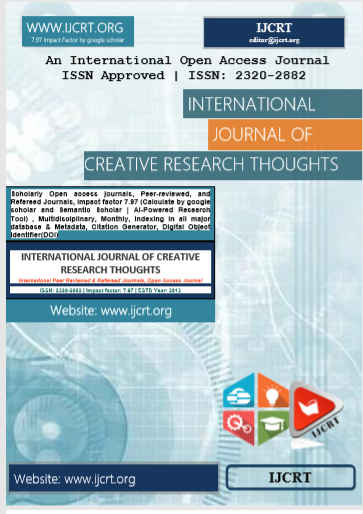
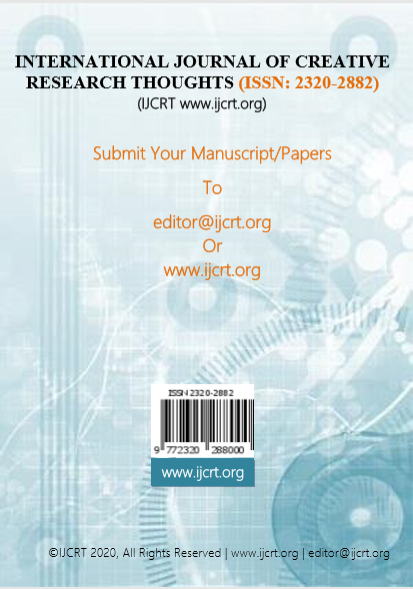
| IJCRT Journal front page | IJCRT Journal Back Page |
Paper Title: Empowered To Be Ensnared
Author Name(s): Dr Priya Uthaiah.I.
Published Paper ID: - IJCRT2607486
Register Paper ID - 311950
Publisher Journal Name: IJPUBLICATION, IJCRT
DOI Member ID: 10.6084/m9.doi.one.IJCRT2607486 and DOI : https://doi.org/10.56975/ijcrt.v14i7.311950
Author Country : Indian Author, India, 570011 , Mysore, 570011 , | Research Area: Medical Science All Published Paper URL: http://ijcrt.org/viewfull.php?&p_id=IJCRT2607486 Published Paper PDF: download.php?file=IJCRT2607486 Published Paper PDF: http://www.ijcrt.org/papers/IJCRT2607486.pdf
Your Paper Publication Details:
Title: EMPOWERED TO BE ENSNARED
DOI (Digital Object Identifier) : https://doi.org/10.56975/ijcrt.v14i7.311950
Pubished in Volume: 14 | Issue: 7 | Year: July 2026
Publisher Name : IJCRT | www.ijcrt.org | ISSN : 2320-2882
Subject Area: Medical Science All
Author type: Indian Author
Pubished in Volume: 14
Issue: 7
Pages: e709-e713
Year: July 2026
Downloads: 75
E-ISSN Number: 2320-2882
Abstract
Empowerment of women in Indian society has been one of the parameters to quantify the ambitious process of emancipation. The 21st century has seen several milestones, including inclusive access to education and employment opportunities. In contradistinction to the widely avowed belief of the inextricability of the male as the patriarchal apotheosis, this article examines the puissant role that the female essays in the incessant perpetuation of patriarchy. The first section introduces the intent of the essay and the references on which the analysis is based. The second part brings to the fore the seamier side of intra-gender relationships. The cause celebre for such viciousness in the association among females is explored in the third section. The fourth section poses questions about empowerment leading to entrapment. The conclusion focuses on how empathy is empowerment in the true sense of the term.
Licence: creative commons attribution 4.0
License
Creative Commons Attribution 4.0 and The Open Definition

Keywords
Empowerment, Emancipation, Empathy, Intersectionality, Patriarchy
License
Creative Commons Attribution 4.0 and The Open Definition
Paper Title: Material Aspirations and Cultural Values in Dollar Bahu: A Feminist Study
Author Name(s): Dr Prarthana Vardhan
Published Paper ID: - IJCRT2607485
Register Paper ID - 312061
Publisher Journal Name: IJPUBLICATION, IJCRT
DOI Member ID: 10.6084/m9.doi.one.IJCRT2607485 and DOI : https://doi.org/10.56975/ijcrt.v14i7.312061
Author Country : Indian Author, India, 226029 , Lucknow, 226029 , | Research Area: Medical Science All Published Paper URL: http://ijcrt.org/viewfull.php?&p_id=IJCRT2607485 Published Paper PDF: download.php?file=IJCRT2607485 Published Paper PDF: http://www.ijcrt.org/papers/IJCRT2607485.pdf
Your Paper Publication Details:
Title: MATERIAL ASPIRATIONS AND CULTURAL VALUES IN DOLLAR BAHU: A FEMINIST STUDY
DOI (Digital Object Identifier) : https://doi.org/10.56975/ijcrt.v14i7.312061
Pubished in Volume: 14 | Issue: 7 | Year: July 2026
Publisher Name : IJCRT | www.ijcrt.org | ISSN : 2320-2882
Subject Area: Medical Science All
Author type: Indian Author
Pubished in Volume: 14
Issue: 7
Pages: e704-e708
Year: July 2026
Downloads: 109
E-ISSN Number: 2320-2882
Abstract
The novelist, Sudha Murty, presents the conflict between material aspiration and traditional values in the novel, Dollar Bahu. The novel explores how the obsession for wealth and social status affects relationship in the family. The story of the novel revolves around the experiences and lives of an Indian middle-class Punjabi family. The couple, Shamanna, a school teacher, and his wife Gouramma, have three children, Chandrashekhar or Chandru, Girish and Surabhi. Chandrashekhar is an engineer who gets settled in America with his wife, Jamuna whereas Girish, a bank employee, lives in India with his wife, Vinuta. Surabhi is an ambitious girl who gets married to Suresh, a lawyer based at Hyderabad. Jamuna represents materialism and modern culture whereas Vinuta represents traditional and moral values. The novel also explores the struggle of women caught between social status and self-respect, family expectations and self-identity, desires and duties, material aspiration and moral values, traditionalism and modernism. The novelist tries to draw our attention towards the importance of moral values and family bonding. The novelist highlights how material aspirations can affect respect and bonding within a family. In fact, the central theme of the novel is the conflict between material values and moral values in our society. The novelist skillfully puts forth how sometimes wealth is mistaken for worth through the initial perspective and perception of Gouramma towards her daughter in laws. Since Gouramma initially views her relationships through the lens of wealth and social status therefore, she praises Jamuna and does not acknowledge the worth of Vinuta. However, when she visits America and observes Jamuna and her lifestyle, Gouramma realizes her fault and understands the true worth of Vinuta and her country. Gouramma's realization of true worth and moral values after returning back to her own country and home, symbolizes the significance of values and togetherness. This research paper analyzes how the novel, Dollar Bahu critiques materialism and its destructive impact on traditional values and family bonding.
Licence: creative commons attribution 4.0
License
Creative Commons Attribution 4.0 and The Open Definition
Keywords
Materialism, cultural values, social status, emotionalism, family bonding.
License
Creative Commons Attribution 4.0 and The Open Definition
Paper Title: Evolution and volatility of Crypto currency in India: An Analysis
Author Name(s): Dr. Dhakshayani M. Dongre
Published Paper ID: - IJCRT2607484
Register Paper ID - 311326
Publisher Journal Name: IJPUBLICATION, IJCRT
DOI Member ID: 10.6084/m9.doi.one.IJCRT2607484 and DOI : https://doi.org/10.56975/ijcrt.v14i7.311326
Author Country : Indian Author, India, 577213 , channagiri, 577213 , | Research Area: Arts1 All Published Paper URL: http://ijcrt.org/viewfull.php?&p_id=IJCRT2607484 Published Paper PDF: download.php?file=IJCRT2607484 Published Paper PDF: http://www.ijcrt.org/papers/IJCRT2607484.pdf
Your Paper Publication Details:
Title: EVOLUTION AND VOLATILITY OF CRYPTO CURRENCY IN INDIA: AN ANALYSIS
DOI (Digital Object Identifier) : https://doi.org/10.56975/ijcrt.v14i7.311326
Pubished in Volume: 14 | Issue: 7 | Year: July 2026
Publisher Name : IJCRT | www.ijcrt.org | ISSN : 2320-2882
Subject Area: Arts1 All
Author type: Indian Author
Pubished in Volume: 14
Issue: 7
Pages: e693-e703
Year: July 2026
Downloads: 102
E-ISSN Number: 2320-2882
Abstract
Abstract Cryptocurrency is a form of digital currency that enables secure financial transactions through cryptographic techniques and distributed computer networks. Unlike conventional currencies issued and regulated by central banks or governments, cryptocurrencies operate on decentralized systems that allow users to exchange value directly without relying on financial intermediaries. The introduction of Bitcoin in 2009 marked the beginning of the modern cryptocurrency era, followed by the emergence of several alternative cryptocurrencies, including Ethereum, Ripple, Litecoin, and Cardano. The underlying technology behind most cryptocurrencies is blockchain, a distributed digital ledger that records every transaction in a secure, transparent, and immutable manner. Transactions are grouped into blocks and linked chronologically, creating a chain that can be publicly verified by network participants. New cryptocurrency units are generally created through a process known as mining, in which complex computational problems are solved to validate transactions and maintain network security. Over the past decade, cryptocurrencies have gained considerable attention as investment assets and alternative payment systems. Their rapid growth has attracted individual investors, businesses, and financial institutions while also raising concerns among economists, central bankers, and policymakers regarding price volatility, regulatory challenges, financial stability, and consumer protection. Despite these concerns, proponents argue that cryptocurrencies offer benefits such as decentralization, transparency, faster transactions, and reduced dependence on traditional banking systems. This study examines the evolution of cryptocurrencies in India with particular emphasis on their volatility, adoption patterns, and the factors influencing their market performance. It also explores the opportunities and challenges associated with cryptocurrency investments within the Indian context and highlights the role of blockchain technology in transforming the digital financial ecosystem. Keywords: Cryptocurrency, Bitcoin, Blockchain, Price Volatility, Digital Assets, Cryptocurrency Adoption, Financial Innovation, Indian Cryptocurrency Market, Regulation, India.
Licence: creative commons attribution 4.0
License
Creative Commons Attribution 4.0 and The Open Definition
Keywords
Keywords: Cryptocurrency, Bitcoin, Blockchain, Price Volatility, Digital Assets, Cryptocurrency Adoption, Financial Innovation, Indian Cryptocurrency Market, Regulation, India.
License
Creative Commons Attribution 4.0 and The Open Definition
Paper Title: Guda Marma: A Review of Classical Concepts and Modern Anatomical Correlation
Author Name(s): Dr. Sneha Mishra, Dr. Snehalata Bagal
Published Paper ID: - IJCRT2607483
Register Paper ID - 312030
Publisher Journal Name: IJPUBLICATION, IJCRT
DOI Member ID: 10.6084/m9.doi.one.IJCRT2607483 and DOI :
Author Country : Indian Author, India, 400084 , Mumbai , 400084 , | Research Area: Health Science All Published Paper URL: http://ijcrt.org/viewfull.php?&p_id=IJCRT2607483 Published Paper PDF: download.php?file=IJCRT2607483 Published Paper PDF: http://www.ijcrt.org/papers/IJCRT2607483.pdf
Your Paper Publication Details:
Title: GUDA MARMA: A REVIEW OF CLASSICAL CONCEPTS AND MODERN ANATOMICAL CORRELATION
DOI (Digital Object Identifier) :
Pubished in Volume: 14 | Issue: 7 | Year: July 2026
Publisher Name : IJCRT | www.ijcrt.org | ISSN : 2320-2882
Subject Area: Health Science All
Author type: Indian Author
Pubished in Volume: 14
Issue: 7
Pages: e688-e692
Year: July 2026
Downloads: 71
E-ISSN Number: 2320-2882
Abstract
Marma is specific location on the body identified as vital region where life force energy known as Prana, reside. All Acharyas have enumerated 107 Marmas, which are further classified into five categories based on its classification, location, size, injury effect etc. Guda Marma is one of 107 Marma described in the literature of Ayurveda. Guda is responsible for the elimination of flatus & faeces. Acharya Sushruta explains it as Mamas Marma, while Vagabhata mentions it as Dhamani Marma. This review aims to analyse the classical descriptions of Guda Marma and correlate them with modern anatomy to understand its structural basis and clinical significance. Classical literature on Guda, Guda Marma, and Guda Valis was reviewed and compared with the anatomy of the anorectal region. The close association of muscular, vascular, and neural structures explains the grave prognosis associated with injury to Guda Marma and supports its designation as a Sadyapranahara Marma. Correlating the classical descriptions with modern anatomy enhances the understanding of Guda Marma and highlights its relevance in anorectal trauma and surgical practice.
Licence: creative commons attribution 4.0
License
Creative Commons Attribution 4.0 and The Open Definition
Keywords
Marma, Guda Marma, Dhamani Marma, Rectum, Anal canal, Anus.
License
Creative Commons Attribution 4.0 and The Open Definition
Paper Title: Filiform Warts Treated with Individualised Homoeopathic Treatment: A Case Report
Author Name(s): Aysha Bushra M, Suman Sankar A S, Richa S K, Surya Gayathri V
Published Paper ID: - IJCRT2607482
Register Paper ID - 311973
Publisher Journal Name: IJPUBLICATION, IJCRT
DOI Member ID: 10.6084/m9.doi.one.IJCRT2607482 and DOI :
Author Country : Indian Author, India, 629161 , kulasekharam,, 629161 , | Research Area: Humanities All Published Paper URL: http://ijcrt.org/viewfull.php?&p_id=IJCRT2607482 Published Paper PDF: download.php?file=IJCRT2607482 Published Paper PDF: http://www.ijcrt.org/papers/IJCRT2607482.pdf
Your Paper Publication Details:
Title: FILIFORM WARTS TREATED WITH INDIVIDUALISED HOMOEOPATHIC TREATMENT: A CASE REPORT
DOI (Digital Object Identifier) :
Pubished in Volume: 14 | Issue: 7 | Year: July 2026
Publisher Name : IJCRT | www.ijcrt.org | ISSN : 2320-2882
Subject Area: Humanities All
Author type: Indian Author
Pubished in Volume: 14
Issue: 7
Pages: e681-e687
Year: July 2026
Downloads: 86
E-ISSN Number: 2320-2882
Abstract
Filiform warts are a distinct subtype of cutaneous warts characterized by their thread like, pointed projections, commonly seen on the face, neck, and eyelids, caused by human papillomavirus (HPV). Their appearance often causes irritation and cosmetic concern, as they resemble fine bristles or tiny brushes. Warts in general represent one of the most frequently encountered dermatological conditions, Standard wart treatments, such as topical applications, cryotherapy, or ablation, often come with side effects and a high chance of recurrence. Homoeopathy, on the other hand, seeks to stimulate the body's natural self regulation to restore balance in a cost effective way.CASE SUMMARY -This case report highlights the case of a 33 year old woman with a painful filiform wart on her scalp. She was prescribed the homoeopathic remedy Staphysagria 200C, based on the patient's comprehensive symptom profile rather than the isolated lesion. The mental symptoms along with particulars showed a marked improvement. With regular monthly follow ups for about 3 months, her warts cleared completely without any topical therapy and with no recurrences. Thus, the patient reported complete resolution of the condition, highlighting the potential role of individualized homeopathic approaches in managing filiform warts.
Licence: creative commons attribution 4.0
License
Creative Commons Attribution 4.0 and The Open Definition
Keywords
Warts, Filiform warts, Homoeopathy, Individualised medicine, homoeopathic treatment, Staphysagria, Modified Naranjo Criteria
License
Creative Commons Attribution 4.0 and The Open Definition
Paper Title: Unmoored Identities: Navigating Diasporic Consciousness in Satendra Nandan's Poetic Landscape
Author Name(s): Anshika Agarwal
Published Paper ID: - IJCRT2607481
Register Paper ID - 312052
Publisher Journal Name: IJPUBLICATION, IJCRT
DOI Member ID: 10.6084/m9.doi.one.IJCRT2607481 and DOI :
Author Country : Indian Author, India, 226001 , Lucknow, 226001 , | Research Area: Medical Science All Published Paper URL: http://ijcrt.org/viewfull.php?&p_id=IJCRT2607481 Published Paper PDF: download.php?file=IJCRT2607481 Published Paper PDF: http://www.ijcrt.org/papers/IJCRT2607481.pdf
Your Paper Publication Details:
Title: UNMOORED IDENTITIES: NAVIGATING DIASPORIC CONSCIOUSNESS IN SATENDRA NANDAN'S POETIC LANDSCAPE
DOI (Digital Object Identifier) :
Pubished in Volume: 14 | Issue: 7 | Year: July 2026
Publisher Name : IJCRT | www.ijcrt.org | ISSN : 2320-2882
Subject Area: Medical Science All
Author type: Indian Author
Pubished in Volume: 14
Issue: 7
Pages: e674-e680
Year: July 2026
Downloads: 87
E-ISSN Number: 2320-2882
Abstract
This paper explores the articulation of diasporic consciousness, trauma, and cultural memory in the poetry of Satendra Nandan, an important voice of the Indo-Fijian diaspora. While focusing on major works from his landmark collection Poems 1975-2025: Waves in the Wounded Sea, specifically the poems "Lines Across Black Waters," "My Father's Son," and "The Old Man and the Scholar," this study examines how postcolonial displacement and the legacy of indentured labour (girmit) are navigated across generations. To understand diasporic theory better, this paper draws upon the theoretical frameworks by Stuart Hall, Avtar Brah, Robin Cohen, and Homi Bhabha to demonstrate the transformation of the historical trauma of crossing the kalapani (black waters) and surviving plantation subjugation to an intergenerational archive. The paper also assesses Nandan's critique of sanitized colonial and institutional histories that are ill-equipped to understand the vernacular Fiji-Hindi oral traditions of aging girmitiyas. Therefore, the paper showcases how Nandan's poetry re-anchors the unmoored Indo-Fijian subject by positing cultural memory not as a static artifact of a lost homeland, but as an active, unquenchable flame that yields dignity, ethical resilience, and identity amidst continuous physical and political exile.
Licence: creative commons attribution 4.0
License
Creative Commons Attribution 4.0 and The Open Definition
Keywords
Diasporic Consciousness, Girmitiya History, Satendra Nandan, Cultural Memory, Indo-Fijian Literature
License
Creative Commons Attribution 4.0 and The Open Definition
Paper Title: Innovative Strategies For Improving Intelligence Test Performance Among 7th Scholarship Students
Author Name(s): Manisha sangmeshwar Kalshetti
Published Paper ID: - IJCRT2607480
Register Paper ID - 312043
Publisher Journal Name: IJPUBLICATION, IJCRT
DOI Member ID: 10.6084/m9.doi.one.IJCRT2607480 and DOI :
Author Country : Indian Author, India, 411019 , Pune, 411019 , | Research Area: Others area Published Paper URL: http://ijcrt.org/viewfull.php?&p_id=IJCRT2607480 Published Paper PDF: download.php?file=IJCRT2607480 Published Paper PDF: http://www.ijcrt.org/papers/IJCRT2607480.pdf
Your Paper Publication Details:
Title: INNOVATIVE STRATEGIES FOR IMPROVING INTELLIGENCE TEST PERFORMANCE AMONG 7TH SCHOLARSHIP STUDENTS
DOI (Digital Object Identifier) :
Pubished in Volume: 14 | Issue: 7 | Year: July 2026
Publisher Name : IJCRT | www.ijcrt.org | ISSN : 2320-2882
Subject Area: Others area
Author type: Indian Author
Pubished in Volume: 14
Issue: 7
Pages: e669-e673
Year: July 2026
Downloads: 66
E-ISSN Number: 2320-2882
Abstract
The Maharashtra 7th Scholarship Examination plays a significant role in identifying academically talented students and promoting higher-order thinking skills. The Intelligence Test component of the examination evaluates logical reasoning, analytical ability, pattern recognition, spatial intelligence, numerical aptitude, and problem-solving skills. Many students experience difficulty in achieving high scores because traditional classroom teaching often focuses more on memorization than reasoning. This paper explores innovative instructional strategies designed to improve students' performance in intelligence tests. The study highlights learner-centred teaching methods such as activity-based learning, gamification, digital learning tools, puzzle-solving sessions, collaborative learning, and continuous formative assessment. These strategies encourage critical thinking, creativity, confidence, and independent problem-solving. The paper concludes that integrating innovative teaching practices into regular classroom instruction can significantly enhance students' intelligence test performance while making learning more engaging and enjoyable.
Licence: creative commons attribution 4.0
License
Creative Commons Attribution 4.0 and The Open Definition
Keywords
Intelligence Test, Scholarship Examination, Innovative Teaching Strategies, Logical Reasoning, Mental Ability, Critical Thinking, Primary Education
License
Creative Commons Attribution 4.0 and The Open Definition
Paper Title: Bahmani Monuments of Kalaburagi: Architectural Heritage of the Deccan
Author Name(s): Dr Guruprakash Hugar
Published Paper ID: - IJCRT2607479
Register Paper ID - 312049
Publisher Journal Name: IJPUBLICATION, IJCRT
DOI Member ID: 10.6084/m9.doi.one.IJCRT2607479 and DOI :
Author Country : Indian Author, India, 585102 , Kalaburagi, 585102 , | Research Area: Social Science All Published Paper URL: http://ijcrt.org/viewfull.php?&p_id=IJCRT2607479 Published Paper PDF: download.php?file=IJCRT2607479 Published Paper PDF: http://www.ijcrt.org/papers/IJCRT2607479.pdf
Your Paper Publication Details:
Title: BAHMANI MONUMENTS OF KALABURAGI: ARCHITECTURAL HERITAGE OF THE DECCAN
DOI (Digital Object Identifier) :
Pubished in Volume: 14 | Issue: 7 | Year: July 2026
Publisher Name : IJCRT | www.ijcrt.org | ISSN : 2320-2882
Subject Area: Social Science All
Author type: Indian Author
Pubished in Volume: 14
Issue: 7
Pages: e663-e668
Year: July 2026
Downloads: 119
E-ISSN Number: 2320-2882
Abstract
Kalaburagi (formerly Gulbarga), the first capital of the Bahmani Sultanate (1347-1424), preserves a remarkable ensemble of Indo Islamic monuments. This article examines the Gulbarga Fort, Jami Masjid, Haft Gumbaz, and Holkunda Necropolis, situating them within the broader cultural and political context of the Deccan. Through architectural analysis and historical interpretation, the study highlights the synthesis of Persianate and indigenous traditions that shaped Bahmani identity.
Licence: creative commons attribution 4.0
License
Creative Commons Attribution 4.0 and The Open Definition
Keywords
Bahmani Sultanate, Kalaburagi monuments, Indo Islamic architecture, Haft Gumbaz, Deccan Sultanates
License
Creative Commons Attribution 4.0 and The Open Definition
Paper Title: PERFORMANCE ANALYSIS OF LONG-SPAN POST-TENSIONED SLAB FOR COMMERCIAL BUILDING USING ETABS
Author Name(s): Fawade Vishal Pandit, Dr. J. M. Chavan
Published Paper ID: - IJCRT2607478
Register Paper ID - 311964
Publisher Journal Name: IJPUBLICATION, IJCRT
DOI Member ID: 10.6084/m9.doi.one.IJCRT2607478 and DOI :
Author Country : Indian Author, India, 413512 , latur, 413512 , | Research Area: Science and Technology Published Paper URL: http://ijcrt.org/viewfull.php?&p_id=IJCRT2607478 Published Paper PDF: download.php?file=IJCRT2607478 Published Paper PDF: http://www.ijcrt.org/papers/IJCRT2607478.pdf
Your Paper Publication Details:
Title: PERFORMANCE ANALYSIS OF LONG-SPAN POST-TENSIONED SLAB FOR COMMERCIAL BUILDING USING ETABS
DOI (Digital Object Identifier) :
Pubished in Volume: 14 | Issue: 7 | Year: July 2026
Publisher Name : IJCRT | www.ijcrt.org | ISSN : 2320-2882
Subject Area: Science and Technology
Author type: Indian Author
Pubished in Volume: 14
Issue: 7
Pages: e651-e662
Year: July 2026
Downloads: 83
E-ISSN Number: 2320-2882
Abstract
Licence: creative commons attribution 4.0
License
Creative Commons Attribution 4.0 and The Open Definition
Keywords
Post-tensioned slab, long-span flooring, ETABS, load balancing, equivalent-load method, serviceability, deflection control, IS 1343:2012.
License
Creative Commons Attribution 4.0 and The Open Definition
Paper Title: POVERTY ALLEVIATION THROUGH GOVERNMENT WELFARE SCHEMES: A CONCEPTUAL REVIEWS.
Author Name(s): S. Deebaq, Dr. P. Magudapathy
Published Paper ID: - IJCRT2607477
Register Paper ID - 311996
Publisher Journal Name: IJPUBLICATION, IJCRT
DOI Member ID: 10.6084/m9.doi.one.IJCRT2607477 and DOI :
Author Country : Indian Author, India, 641006 , coimbatore, 641006 , | Research Area: Arts1 All Published Paper URL: http://ijcrt.org/viewfull.php?&p_id=IJCRT2607477 Published Paper PDF: download.php?file=IJCRT2607477 Published Paper PDF: http://www.ijcrt.org/papers/IJCRT2607477.pdf
Your Paper Publication Details:
Title: POVERTY ALLEVIATION THROUGH GOVERNMENT WELFARE SCHEMES: A CONCEPTUAL REVIEWS.
DOI (Digital Object Identifier) :
Pubished in Volume: 14 | Issue: 7 | Year: July 2026
Publisher Name : IJCRT | www.ijcrt.org | ISSN : 2320-2882
Subject Area: Arts1 All
Author type: Indian Author
Pubished in Volume: 14
Issue: 7
Pages: e645-e650
Year: July 2026
Downloads: 80
E-ISSN Number: 2320-2882
Abstract
ABSTRACT Poverty remains one of the most persistent developmental challenges confronting the Indian state, and successive governments since independence have responded through an evolving architecture of welfare schemes designed to lift disadvantaged households above the poverty line. This paper undertakes a conceptual review of poverty alleviation programmes in India, tracing their historical evolution, classifying them according to their design logic, and synthesising the accumulated body of scholarship on their outcomes. Drawing exclusively on secondary sources such as government reports, planning commission documents, and peer-reviewed literature, the paper argues that Indian poverty alleviation policy has moved through discernible phases: an early emphasis on agricultural growth and community development, a subsequent turn toward targeted self-employment and wage-employment schemes, and a more recent phase centred on rights-based guarantees and direct benefit transfers. The review finds that while individual schemes have recorded measurable gains in employment generation, food security and asset creation, cross-cutting problems of targeting error, leakage, corruption and weak last-mile administration continue to blunt their poverty-reducing potential. The paper concludes by identifying gaps in the literature, particularly the relative neglect of the social and psychological dimensions of poverty, and by outlining directions for future district-level empirical research.
Licence: creative commons attribution 4.0
License
Creative Commons Attribution 4.0 and The Open Definition
Keywords
Keywords: poverty alleviation, welfare schemes, social security, self-employment programmes, wage employment, India
License
Creative Commons Attribution 4.0 and The Open Definition
Call For Paper September 2026
Call For Papers
September 2026
Volume 14 | Issue 9
Last Date :
31-Oct-2026
Submit Manuscript Online Impact Factor: 7.97 Review Results : Within 02-03 Days Paper Publication : Within 02-03 Days
September 2026
Volume 14 | Issue 9
Last Date :
31-Oct-2026
Submit Manuscript Online Impact Factor: 7.97 Review Results : Within 02-03 Days Paper Publication : Within 02-03 Days
Published Issue Details
For Authors
Forms / Downloads
Other IMP Links
Indexing Partner
Research Area
LICENSE





ISSN and 7.97 Impact Factor Details
ISSN: 2320-2882 Impact Factor: 7.97 and ISSN APPROVED Journal Starting Year (ESTD) : 2013


ISSN and 7.97 Impact Factor Details
ISSN: 2320-2882 Impact Factor: 7.97 and ISSN APPROVED Journal Starting Year (ESTD) : 2013
DOI Details
CONFERENCE
CONFERENCE MANAGMENT & PUBLICATION CONFERENCE PROPOSAL
RECENT CONFERENCE

CONFERENCE PROPOSAL CONFERENCE PROCEEDINGS
CONFERENCE PROPOSAL CONFERENCE PROCEEDINGS
For Reviewer /Referral (RMS) Earn 500 per paper
Important Links
NEWS & Conference
Digital Library
IJCRT RMS | Earn 500 Per Paper.

Open Access


LICENSE
Indexing Partner
Scholarly open access journals, Peer-reviewed, and Refereed Journals, Impact factor 7.97 (Calculate by google scholar and Semantic Scholar | AI-Powered Research Tool) , Multidisciplinary, Monthly, Indexing in all major database & Metadata, Citation Generator, Digital Object Identifier(DOI)